

Your message has been successfully sent.
Our managers will definitely contact you
Use of Toilet Paper and Paper Towels in Different Countries Around the World
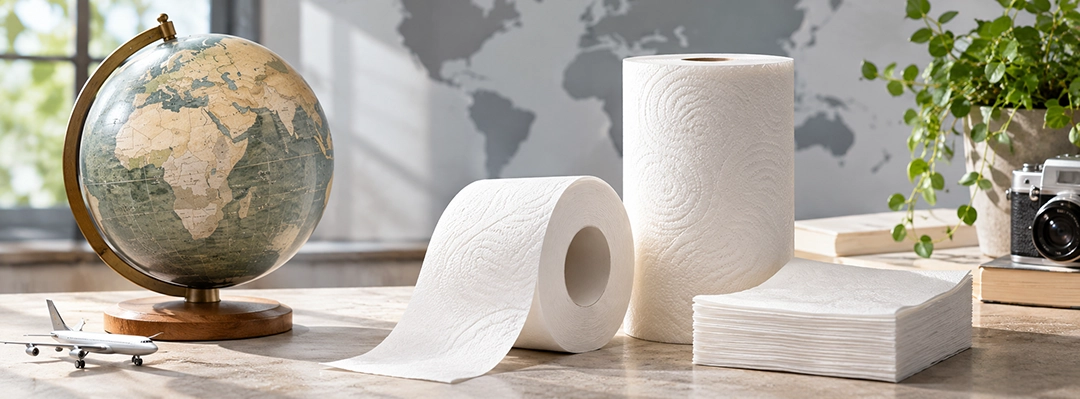
There are countless aspects of our everyday lives that shape our culture, from food and music preferences to the way we use toilet paper. Although it may seem unusual to us, there are countries where people do not use toilet paper at all after using the toilet.It may be difficult for us to imagine that different cultures have different approaches to personal hygiene. Many of us might wonder how people maintain proper hygiene after using the toilet without toilet paper. So, if you are planning to travel around the world, it might be a good idea to bring some toilet paper with you!
Paper, Water, or Hands: Which Is Better?
If people in some countries do not use toilet paper, what do they use instead?In many cultures, rather than wiping with paper, people wash themselves with water, using a bowl, a container, or other washing facilities.In other cultures, it is customary to cook, eat, and greet others using only the right hand. This is because the left hand is traditionally reserved for personal hygiene after using the toilet.In these countries, greeting someone with your left hand may be considered rude, disrespectful, or even offensive. When visiting another country, it is polite to learn about local customs beforehand to avoid accidentally offending or embarrassing local residents.
1.India. Tourists are often surprised to discover that toilet paper is not always readily available. Although it can be found in hotels and some shops in tourist areas, many homes and public restrooms do not provide it. Instead, people commonly use water for personal hygiene after using the toilet.
2.France, Portugal, Italy, and Japan. Bidets are commonly used in bathrooms in these countries as an alternative or complement to toilet paper. A bidet is a bathroom fixture designed for washing with water. Some bidets are separate fixtures located next to the toilet, while others are integrated into the toilet itself.
3.Major European Cities and the United States. In many large European cities, using public restrooms may require a fee, and access to toilet paper may sometimes be limited or subject to additional charges. Nevertheless, toilet paper is an essential everyday product in these regions and is widely available in supermarkets and convenience stores.
4.Tunisia, Morocco, Egypt, and Jordan. Water is also commonly used for personal hygiene after using the toilet in these countries.
Why Do We Use Toilet Paper?
We are regular consumers of toilet paper. Almost every Ukrainian uses toilet paper in everyday life. It is a standard hygiene product found in household bathrooms and public restrooms.We use toilet paper for personal hygiene, particularly for cleaning ourselves after using the toilet, wiping our noses, and other everyday needs.Toilet paper is affordable, useful, and practical in our culture. However, there are different opinions regarding its effectiveness. Some people argue that toilet paper is not necessarily the most hygienic option compared to washing with water.Nevertheless, using toilet paper is deeply ingrained in our daily habits, and it is unlikely that we will completely change these practices, especially when high-quality paper products are available.
One example is toilet paper made from environmentally friendly recycled raw materials with the addition of disinfecting agents offering a broad spectrum of antimicrobial activity.This is the composition described for Kokhavynka toilet paper, a product designed to provide comfort from the very first touch. Its pleasant texture makes it comfortable to use and helps reduce the risk of skin irritation and damage.