

Your message has been successfully sent.
Our managers will definitely contact you
How Much Does Paper Cost per 1,000 Restroom Visits? Calculating Restroom Paper Consumption
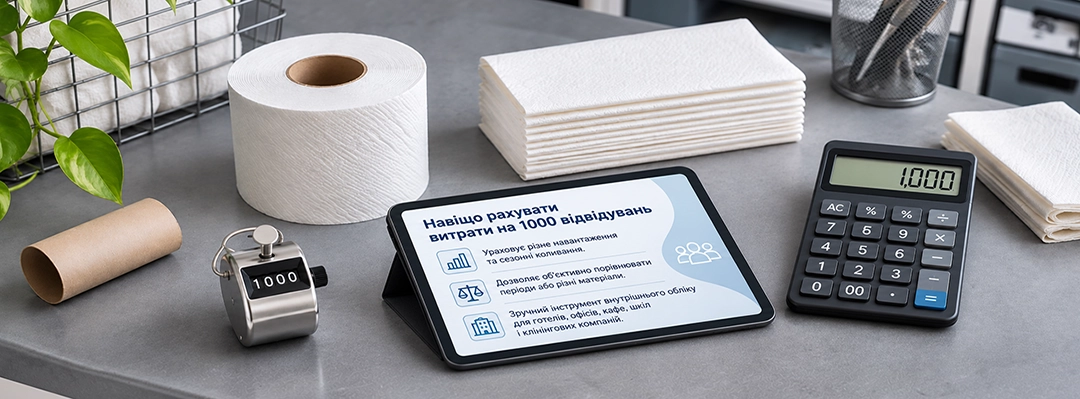
Tracking paper consumption in restrooms helps estimate costs more accurately than simply looking at the price of a package. To calculate the cost of paper per 1,000 restroom visits, divide the cost of toilet paper and paper towels actually used by the number of restroom visits during the same period, then multiply by 1,000.There is no universal cost that applies to every facility. The result depends on the products, dispensing equipment, and usage patterns. Below, we explain what data to collect and how to perform the calculation.
At a Glance
- Calculate toilet paper and paper towel costs separately, then add them together.
- Use the number of restroom visits, not the total number of guests at the facility.
- Account for paper remaining in dispensers: refilling a dispenser does not necessarily mean the paper has been consumed.
- Compare periods with similar traffic levels and no interruptions in paper availability.
- Separate material costs from equipment, delivery, and maintenance expenses.
Why Calculate Paper Costs per 1,000 Restroom Visits?
Monthly expenses may increase because more people use the restroom, even if paper is being used efficiently. Conversely, a reduction in purchases may result from using existing warehouse stock rather than actual savings.
The cost per 1,000 visits helps account for different levels of restroom traffic. It can be used to compare different operating periods at the same facility or evaluate the results of testing different paper products.
For hotels, offices, cafés, schools, and cleaning companies, this is primarily an internal cost-tracking tool. Figures from different facilities should not be compared without considering their users, equipment, and usage patterns.
What Data Do You Need for the Calculation?
Number of Restroom Visits
One restroom visit represents one recorded entry by a user. It does not necessarily mean one unique person: an office employee may visit the restroom several times throughout the day.
Determine how entries will be counted. If a people counter is installed, check whether it counts both entries and exits and how it records cleaning and maintenance staff.
If accurate tracking is unavailable, you can make a preliminary estimate, but clearly identify it as approximate. Do not automatically equate the number of restaurant receipts or office employees with the number of restroom visits.
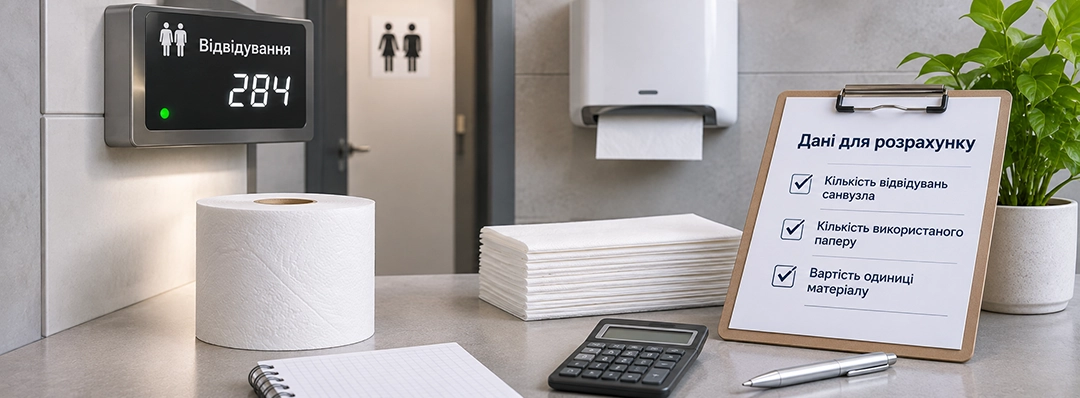
Amount of Paper Used
For toilet paper, it is convenient to track consumption in meters. For folded paper towels, use sheets; for paper towel rolls, use meters. Keep the units consistent within each calculation.
The basic formula is:
Quantity used = Opening stock + Stock received − Closing stock.
The inventory boundaries must remain consistent. If you are tracking stock within the restroom, include paper in dispensers and the local reserve. Record returns to the warehouse or transfers to another area separately.
Cost per Unit of Material
For toilet paper, calculate the price per meter by dividing the price of one roll by its length. For folded paper towels, divide the package price by the number of sheets.
If different products are used, calculate their costs separately. Do not apply the price of one product to the total length of all rolls if their prices differ.
How to Calculate Restroom Paper Consumption
First, calculate the physical consumption per 1,000 restroom visits:
Consumption per 1,000 visits = Quantity of paper used ÷ Number of visits × 1,000.
Then convert consumption into monetary terms:
Cost per 1,000 visits = Cost of paper used ÷ Number of visits × 1,000.
Calculate toilet paper and paper towels separately. Then add the amounts to determine the total cost of paper supplies per 1,000 restroom visits.
This figure does not represent the full cost of restroom operation. It excludes water, cleaning products, cleaning services, and other expenses unless they are added separately.
Calculation Example: Toilet Paper and Folded Paper Towels
All figures below are hypothetical. This is an illustrative example, not a consumption standard or a commercial offer from the factory.
Suppose that 2,000 restroom visits were recorded during the reporting period. After accounting for opening and closing stock, 600 meters of toilet paper and 3,000 folded paper towel sheets were used.
A 100-meter roll of toilet paper costs UAH 60. The price per meter is UAH 0.60, so 600 meters cost UAH 360. The cost per 1,000 visits is UAH 180: 360 ÷ 2,000 × 1,000.
A pack of 200 paper towel sheets costs UAH 40. One sheet costs UAH 0.20, so 3,000 sheets cost UAH 600. The cost per 1,000 visits is UAH 300: 600 ÷ 2,000 × 1,000.
In total, the paper supplies in this example cost UAH 480 per 1,000 restroom visits: 180 + 300.
This is an average figure for the entire restroom, not a claim that every visitor used the same amount of paper.
Why Cheaper Packaging Does Not Always Reduce Costs
A lower purchase price may be accompanied by higher actual consumption. For example, users may take more sheets because of their size or the way they are dispensed.
Therefore, when comparing toilet paper for businesses, consider roll length, paper width, number of plies, and comfort. For paper towels, absorbency and wet strength are also important.
Which Specifications Affect Consumption?
For toilet paper, check roll length, perforated sheet dimensions, number of plies, and holder compatibility. Dispenser-compatible products also require checking the outer roll diameter and inner core diameter.
When choosing folded paper towels, compare V-fold or Z-fold formats, folded and unfolded sheet dimensions, and sheet count.
For paper towel rolls, check roll length, paper width, and dispensing method.
If the specifications include a value in g/m², clarify whether it refers to a single ply or the finished multi-ply sheet.
The number of plies and basis weight alone are not sufficient to predict a specific percentage of savings.
How to Compare Two Paper Products
Conduct consecutive tests in the same restroom under comparable conditions. Choose periods that reflect typical operations rather than a single quiet or exceptionally busy day.
- Record the product code, price, specifications, and opening stock.
- Check paper compatibility with existing dispensers.
- Track refills, returns, and write-offs.
- Record restroom visits and closing stock.
- Compare costs per 1,000 visits and ease of use.
Avoid changing the paper, equipment, and maintenance procedures at the same time if you want to evaluate the impact of the material alone. If changes are unavoidable, document them in the results.
A period during which paper ran out or a dispenser was not working does not demonstrate product efficiency. Lower consumption caused by unavailable supplies distorts the comparison.
How to Control Waste and Plan Purchases
Include paper written off because of damage or moisture in your costs, but record it separately. This helps distinguish normal consumption from losses caused by storage or maintenance.
Do not discard usable leftover paper simply to simplify calculations. For partially used rolls, apply a consistent estimation method and acknowledge that the results are approximate.
After measuring consumption, calculate projected demand:
Projected demand = Consumption per 1,000 visits × Expected number of visits ÷ 1,000.
Add a reserve based on possible fluctuations in traffic and the agreed delivery lead time.
Kokhavynka Paper Mill manufactures products from cellulose and recycled raw materials.
Wholesale customers benefit from manufacturer prices and volume-based discounts. The minimum order quantity is one pallet.
Self-pickup and delivery using the factory’s own vehicles are available. The estimated delivery lead time starts from five days, with the exact schedule agreed upon when placing an order.
To choose the right product format and plan your purchase, contact our factory specialists. Provide the dispenser model, recorded paper consumption, and expected restroom traffic.
Frequently Asked Questions
How Much Toilet Paper Is Needed per 1,000 Restroom Visits?
There is no reliable universal quantity without measuring consumption in a specific restroom.
Determine the total length of toilet paper used during a given period, divide it by the number of visits, and multiply by 1,000.
Account for remaining stock, losses, and transfers of materials.
Use the result as your own consumption benchmark rather than a standard applicable to all facilities.
How Do You Calculate Paper Towel Consumption?
For folded paper towels, determine the number of sheets used:
Opening stock plus stock received minus closing stock, adjusted for transfers.
Divide the result by the number of restroom visits and multiply by 1,000.
For paper towel rolls, apply the same method using meters instead of sheets.
Track different products separately, especially if their dimensions and prices differ.
Can Paper Consumption Be Calculated Based on the Number of Employees?
The number of employees can be used to calculate a separate metric, such as paper consumption per employee per day or month.
However, the number of employees is not equal to the number of restroom visits. People use restrooms at different frequencies, and visitors may also use the facilities.
Calculating consumption per 1,000 visits requires an actual entry count or a clearly identified estimate.
Why Didn’t Costs Decrease After Switching Paper Products?
Possible reasons include higher material consumption, different sheet sizes, dispenser incompatibility, or changes in restroom traffic.
Check the unit price, number of visits, correct dispenser loading, and remaining stock.
Compare equivalent reporting periods.
A lower package price alone is not enough to conclude that the product provides savings under actual operating conditions.
What Is Included in the Cost of Paper per 1,000 Restroom Visits?
The basic calculation includes the cost of toilet paper and paper towels used, including recorded write-offs.
Delivery, maintenance, and equipment expenses can be added as separate cost components.
It is important to apply the same calculation method in all comparisons and not describe the cost of paper supplies as the total cost of restroom operation.
Need help choosing paper products for your facility? Contact a factory specialist using the contact form or phone number provided on our website.